Stuck in the Same Pew: How the People Who Irritate Us Most Become Our Greatest Teachers of Grace
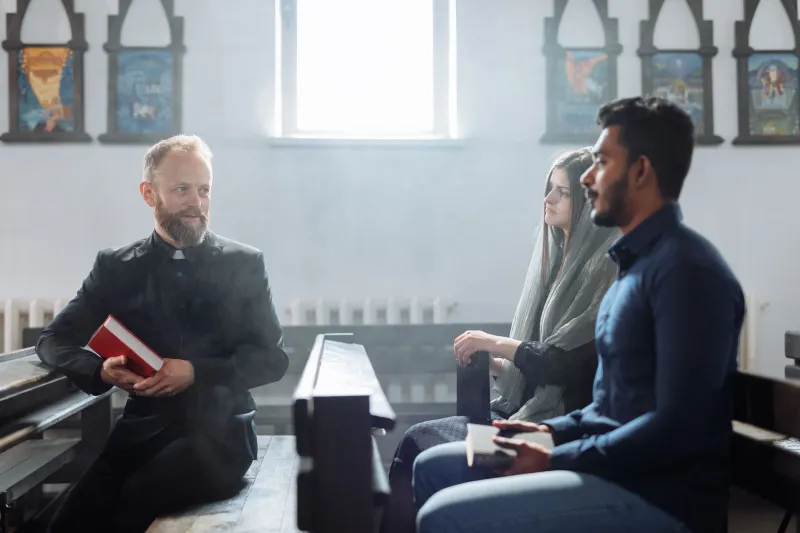
There is a woman in nearly every congregation who arrives precisely three minutes after the service begins, shuffles past four seated worshippers with a rustling coat and a large travel mug, and settles herself with an audible sigh directly beside you. You know her. You may have quietly rearranged your arrival time to avoid her. And if you are honest with yourself, you have wondered—at least once—whether God is testing you specifically.
The digital age has handed us extraordinary power over our own comfort. We curate our news feeds, mute acquaintances whose opinions we find exhausting, and build social circles of remarkable ideological coherence. This is not entirely a bad thing. But it has made the local church's most ancient and underappreciated gift feel almost countercultural: the stubborn, un-algorithmic reality of being placed beside people we did not choose.
At Asbury UMC Madison, we believe that community is not incidental to faith. It is, in fact, one of its primary laboratories.
The Problem with a Perfectly Curated Faith
Spiritual formation has never been a solitary project, though American individualism persistently tempts us to treat it as one. We speak of personal relationships with God, private devotional lives, individual salvation journeys—and while each of these has genuine value, the grammar of isolation can quietly hollow out what faith is meant to produce in us.
John Wesley, the founder of Methodism, was deeply suspicious of what he called "solitary religion." His famous declaration that "there is no holiness but social holiness" was not merely a call to social justice, as it is sometimes interpreted today. It was a theological claim about the very mechanics of sanctification: that we are made holy together, through the friction and grace of genuine community, not in spite of it.
When we retreat into faith communities that mirror our own politics, aesthetics, and life choices—or when we consume spirituality primarily through podcasts and curated online content—we are, however inadvertently, opting out of one of the central engines of Christian growth. We are choosing the frictionless path. And friction, it turns out, is precisely what polishes.
What Methodist Theology Says About Being Annoyed
Wesleyan theology offers a rich framework for understanding what happens in the uncomfortable spaces of congregational life. At its heart is the doctrine of prevenient grace—the conviction that God's grace is already at work in every human being, even before they recognize it, even before they have done anything to deserve it. Every person in the pew beside you, regardless of how they vote, how they raised their children, or whether they talk too loudly during the passing of the peace, carries within them the active presence of divine grace.
This is not a sentimental claim. It is a theological one, and it carries practical weight. If grace is genuinely present in the person whose worldview troubles you, then your irritation with them is not simply a personality conflict to be managed. It is a spiritual invitation to look harder—to seek the image of God in a face that does not make it easy for you.
Methodism also holds a robust theology of accountability. The early Methodist class meetings, small gatherings of believers who met weekly to ask one another hard questions about their spiritual lives, were deliberately not sorted by affinity. They were mixed, messy, and deeply personal. The accountability they practiced was not the accountability of people who already agreed with one another. It was the accountability of people who had covenanted to be honest with one another precisely because they were different.
The Specific Spiritual Work of Staying
There is a kind of spiritual maturity that only develops through sustained proximity to people who challenge us. Psychologists sometimes call this "tolerance of ambiguity"—the capacity to remain in relationship with complexity rather than resolving it prematurely. In theological terms, we might call it patience, or more precisely, the long obedience of love.
Consider what actually happens when you remain in community with someone who unsettles you, week after week, year after year. You begin, slowly and involuntarily, to learn their story. You discover that the political opinion you found so offensive is rooted in a grief you did not know about. You find out that the habit that annoyed you is a coping mechanism for something genuinely hard. You realize, with some embarrassment, that you have been reacting to a caricature rather than a person.
This is not a guarantee. Some long-term proximity produces only calcified resentment. But when it is held within a community that takes Wesley's vision of social holiness seriously—when there are structures of care, honest conversation, and shared worship that keep people in genuine relationship—something else becomes possible. The person who irritated you becomes, improbably, someone you love.
That transformation is not tolerance. Tolerance is the gritted-teeth decision to endure someone. What we are describing is something far more demanding and far more beautiful: the slow, grace-assisted work of coming to see another human being whole.
Practical Wisdom for the Difficult Pew
None of this means that every difficult relationship in a faith community must be preserved at all costs, or that genuine harm should be endured in the name of spiritual growth. There are real limits, and healthy communities name them clearly.
But for the ordinary friction of congregational life—the person whose theology is more conservative than yours, the family whose parenting choices you quietly judge, the longtime member whose personality has always rubbed you wrong—there are some practices worth considering.
Seek the story before the verdict. Before you have fully formed your opinion of someone, ask yourself how much of their actual life you know. Most judgments are made on thin evidence. A single conversation over coffee after a Sunday service can dismantle a year's worth of assumptions.
Name the irritation honestly in prayer. Do not spiritualize it away. Bring the actual feeling—the annoyance, the judgment, the weariness—before God and ask what it might be revealing about you, not just about them.
Stay at the table. In a culture that celebrates the exit, choosing to remain is itself a countercultural act. Show up the next Sunday. Sit in the same general vicinity. Let the liturgy do its slow work of reminding you that you are both held by the same grace.
Look for the grace already present. This is the specifically Wesleyan practice: to actively search for evidence of God's prevenient work in the person who confounds you. It is not naïve. It is disciplined. And it changes what you are able to see.
The Church as Uncommon Ground
In Madison, as in most American cities, it has never been easier to live entirely within a community of people who think and live exactly as you do. Our neighborhoods, our schools, our media consumption, and our social lives are all, to varying degrees, sorted by affinity. The church has an opportunity—and, we would argue, a responsibility—to be something different.
Asbury UMC Madison is not a perfect community. We hold genuine differences on questions of theology, politics, and practice. We do not always handle those differences with grace. But we keep coming back to the same table, singing the same hymns, and being confronted by the same gospel that insists, with quiet relentlessness, that our neighbors—all of them—are beloved.
The woman with the travel mug and the rustling coat may be the most important spiritual teacher you have this year. The question is whether you are willing to stay long enough to find out.