When Belief Bends: The Spiritual Courage It Takes to Think Differently Inside a Faith Community
There is a particular kind of loneliness that settles in when you begin to question something you once believed wholeheartedly — and you are not sure anyone around you will understand. You sit in the familiar surroundings of a sanctuary you have attended for years, surrounded by people you trust, and yet a quiet internal shift is underway that you cannot quite name. What do you do with a conviction that no longer fits the person you are becoming?
This is not a crisis of faith. For many people walking through the doors of Asbury UMC Madison, it is actually the beginning of one.
The Myth of the Static Believer
American religious culture has long carried an unspoken assumption: that mature faith is settled faith. We tend to treat certainty as a virtue and revision as a sign of weakness or wavering commitment. The believer who announces, "I used to think this, but I have changed my mind," is sometimes met with suspicion rather than celebration.
But a closer reading of Scripture — and of church history — tells a different story. The apostle Peter, confronted with a vision he could not explain, revised a deeply held conviction about who belonged at God's table. The early church, gathered in councils and conflict, wrestled publicly with what the faith actually required. Theologians across centuries have refined, retracted, and rebuilt doctrinal positions not out of faithlessness but out of faithfulness to truth.
Changing your mind, it turns out, has always been part of the spiritual journey.
What a Community Makes Possible
The difference between changing your mind in isolation and changing your mind within a community is significant. Alone, revision can feel like collapse. Inside a community grounded in grace, it can feel like growth.
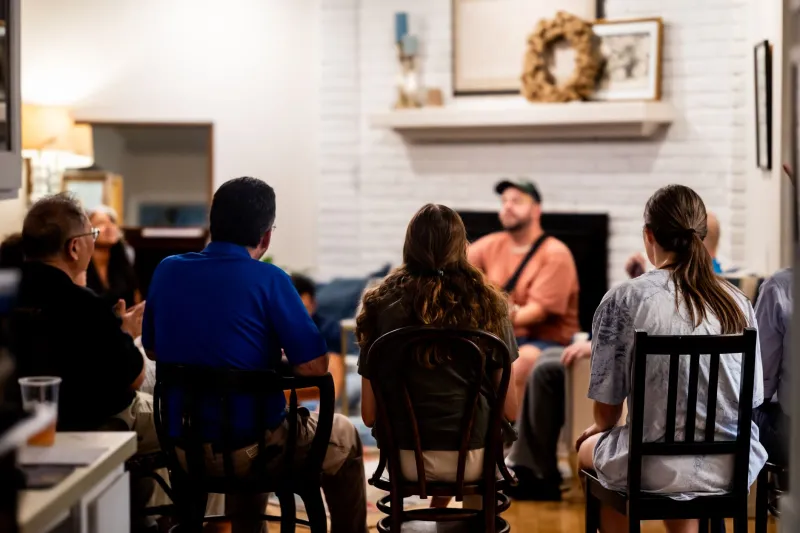
At Asbury UMC Madison, we have intentionally cultivated spaces where that kind of growth is not only permitted but encouraged. Our small group gatherings, adult education forums, and Wednesday evening discussions are structured around the conviction that honest questions deserve honest engagement — and that no one should have to pretend certainty they do not possess.
Margaret, a longtime Asbury member who asked that her last name not be used, described the shift she experienced after joining one of our Thursday morning Bible study groups three years ago. She had spent decades holding a fairly rigid view of who was and was not welcome in the church's full life. "I thought I was being faithful," she said. "Then I started actually listening to people whose experiences I had never considered. It didn't happen overnight. But something opened up in me."
What opened up, she says, was not a loss of faith but a deepening of it — one that now feels more spacious, more honest, and more aligned with the God she reads about in the Gospels.
The Role of Structured Dialogue
Shifts like Margaret's rarely happen through argument alone. They tend to emerge from sustained relationship — from sitting across a table from someone whose life experience genuinely differs from your own, sharing coffee, sharing Scripture, and sharing the kind of vulnerability that formal debate rarely allows.
This is why Asbury UMC Madison invests so deliberately in structured dialogue as a form of spiritual formation. Our pastoral team regularly designs programming around difficult questions: questions about justice, about inclusion, about how ancient texts speak to contemporary realities. These are not debates staged for entertainment. They are invitations to think carefully, feel honestly, and remain in relationship even when conclusions differ.
Rev. Dana Whitmore, one of our associate ministers, often frames it this way in her teaching: "If your faith can only survive agreement, it hasn't been tested yet. The community is where the testing happens — and where grace catches you when your certainties give way."
That framing — grace as the net beneath intellectual risk — captures something essential about what a progressive faith community can offer that individual study alone cannot.
Intellectual Maturity as Spiritual Discipline
There is a tendency to treat intellectual and spiritual growth as parallel tracks that occasionally intersect. What we have found at Asbury UMC is that they are, at their best, the same track.
When James, a retired professor who joined Asbury five years ago after decades away from organized religion, began attending our adult forum series on theology and social ethics, he expected an academic exercise. What he encountered instead was something more disorienting and more transformative. "I came in thinking I would sharpen my arguments," he said. "I left — eventually — having softened my certainties. That's a different kind of education."
The softening James describes is not intellectual surrender. It is the hard-won recognition that the questions we bring to faith are often more revealing than the answers we arrive with. A community that can hold that tension — that can honor both the rigor of inquiry and the warmth of belonging — is performing one of its most vital functions.
Permission to Become
One of the quietest gifts a faith community offers is permission: permission to be someone who is still becoming. In a culture that rewards confident positioning and penalizes visible uncertainty, the church at its best offers a countercultural shelter — a place where "I used to believe, and now I am not so sure" is received not as failure but as faithfulness.
At Asbury UMC Madison, we take seriously the Wesleyan tradition's emphasis on sanctification — the ongoing, lifelong process of being shaped more fully into the image of grace. That tradition has always understood that growth is not a destination but a direction. You do not arrive at spiritual maturity; you move toward it, imperfectly, in the company of others doing the same.
This means that changing your mind — about theology, about ethics, about who God is and who belongs to God's community — is not a detour from the spiritual life. It is, more often than we acknowledge, the spiritual life itself.
An Invitation, Not a Demand
None of this is to suggest that Asbury UMC Madison asks its members to abandon conviction or treat all beliefs as equally valid. Intellectual humility is not the same as intellectual indifference. We hold commitments — about justice, about the dignity of every person, about the radical welcome of the Gospel — and we hold them seriously.
But we also hold them with open hands, trusting that the Spirit has not finished speaking, that the community has not yet exhausted what it has to teach us, and that the person sitting beside us in worship may carry a piece of truth we have not yet encountered.
If you find yourself in a season of quiet revision — if old certainties are shifting and you are not sure where to bring that — we want you to know that there is room for you here. Not just room to belong, but room to become.
That, we believe, is what a church is for.