The Gift of Different Ages: Why Multigenerational Faith Is Becoming the Church's Most Vital Renewal
For the better part of three decades, conventional wisdom in American church growth circles held that age-targeted ministry was the path forward. Youth groups for teenagers. Young adult services with contemporary music. Senior programming on Tuesday afternoons. The logic was intuitive: people connect most naturally with those who share their life stage, their cultural references, their specific pressures and pleasures. Segment the congregation, the theory went, and everyone will feel seen.
The results have been, at best, mixed. And increasingly, the people sitting in pews — or declining to sit in them at all — are telling us something different.
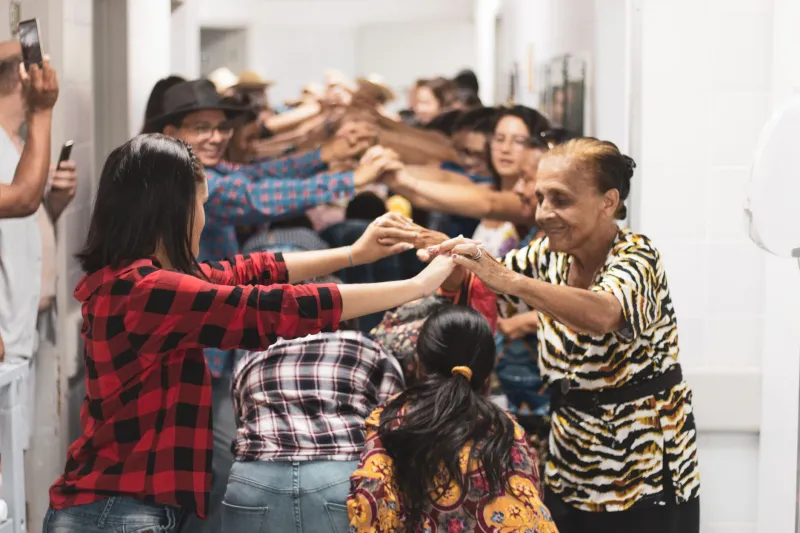
Across the United States, a quiet but unmistakable hunger is emerging for something that age-sorted ministry cannot provide: the experience of genuine community across generational lines. Younger adults are seeking the wisdom, steadiness, and perspective that older believers carry. Older members are finding renewed purpose and vitality in relationships with younger generations who challenge, energize, and inspire them. Families are discovering that when their children know the names of the elderly couple three rows back — and vice versa — something essential about their faith formation takes root in a way that no curriculum alone can accomplish.
At Asbury United Methodist Church in Madison, we have been paying close attention to this shift. And we believe it represents not merely a trend, but a recovery of something the church has always known and periodically forgotten.
The Sorting Problem
American culture has become extraordinarily efficient at sorting people by age. Schools, workplaces, housing developments, social media platforms, entertainment options — nearly every major institution tends to cluster people within narrow generational bands. This is not inherently malicious. Much of it reflects genuine practical convenience. But its cumulative effect is a society in which many people have almost no sustained, meaningful relationships with anyone more than a decade older or younger than themselves.
The consequences are well-documented and sobering. Younger people report epidemic levels of loneliness and a deficit of mentorship. Older adults describe isolation, irrelevance, and a sense that their hard-won experience carries no currency in contemporary life. Children growing up without regular contact with grandparent-aged adults miss the particular quality of unconditional, unhurried attention that older people are often uniquely positioned to offer.
The church, at its best, has always been a counter-cultural institution. The early Christian communities described in the New Testament were striking precisely because they gathered people across every social division — ethnicity, economic class, gender, and yes, age. The image of the body of Christ in 1 Corinthians 12 is explicitly about the irreplaceable contribution of every distinct part. A body composed only of people born between 1990 and 2000 is not, by this reckoning, a complete body at all.
What Younger Generations Are Actually Looking For
The data on Millennial and Gen Z religious disaffiliation has been exhaustively analyzed, and the conclusions are often framed in terms of what younger people are fleeing: perceived hypocrisy, rigid dogma, political entanglement, institutional irrelevance. These concerns are real and deserve serious engagement.
But there is an equally important and less frequently examined question: what are younger people moving toward? What would actually draw them into sustained, committed participation in a faith community?
The answers that emerge consistently from research and pastoral conversation are revealing. Younger adults are not, by and large, seeking entertainment or relevance defined as cultural mimicry. They are seeking authenticity. They are seeking communities where depth of relationship is valued over breadth of programming. They are seeking elders — not authority figures who demand deference, but seasoned human beings who will sit with them in their confusion, share their own stories of failure and grace, and offer the particular gift of perspective that only lived experience can provide.
In short, they are seeking exactly what age-sorted ministry cannot give them.
What Older Generations Rediscover
The exchange, of course, moves in both directions. Older members of faith communities who enter genuine relationship with younger generations consistently report something that might be called spiritual reactivation. The questions that younger people bring — raw, unmediated, undefended by decades of theological habituation — have a way of pressing older believers back into direct encounter with the foundations of their own faith.
One member of our Asbury congregation, a retired educator in her early seventies, described her experience co-leading an intergenerational small group this past year. "I thought I was there to offer something," she said. "And I was. But what I didn't expect was how much their questions would make me re-examine things I thought I'd settled long ago. It's made my faith more alive, not less."
This dynamic — mutual revitalization rather than one-directional mentorship — is characteristic of the healthiest intergenerational faith relationships. It reflects the theological conviction that the Spirit distributes gifts without regard to birth year, and that wisdom is not the exclusive property of the old any more than energy is the exclusive property of the young.
How Asbury UMC Is Creating Intergenerational Space
Building genuine intergenerational community requires intentionality. It does not happen automatically simply by placing people of different ages in the same room. It requires shared experience, structured opportunity for relationship, and a congregational culture that explicitly values cross-generational connection.
At Asbury UMC, several initiatives have proven particularly fruitful. Our intergenerational small groups deliberately mix age cohorts and provide facilitated conversation around shared Scripture study and life reflection. Our mentorship pairing program connects older members with young adults navigating major life transitions — not as advisors dispensing answers, but as companions in discernment. Our family worship model integrates children and youth into the full liturgical life of the congregation rather than routing them exclusively into age-segregated programming.
We have also found that service projects — working alongside one another toward a common goal — create some of the most natural and durable intergenerational bonds. There is something about shared effort, shared inconvenience, and shared satisfaction that dissolves the awkwardness of age difference more efficiently than any structured icebreaker.
A Church for All Seasons of Life
The United Methodist tradition has always held a capacious vision of the church as a community that encompasses the full arc of human life — birth, growth, struggle, maturity, loss, and death. Our Wesleyan theology of grace understands each of these seasons as carrying its own spiritual gifts and its own particular vulnerabilities. A community that holds all of these seasons simultaneously is, by definition, richer, more resilient, and more fully human than one that has sorted itself by age.
We believe that the growing hunger for intergenerational connection is not a passing trend. It is a recognition — felt in the bones of people across the generational spectrum — that we were not designed to navigate life in age-segregated silos. We were designed for community in its fullest, most complex, most rewarding sense.
At Asbury UMC Madison, every age is welcome, every season of life is honored, and every generation has something irreplaceable to offer. We invite you to come and discover what the gift of different ages can mean for your own faith journey. Find us at asburyumcmadison.com, or join us any Sunday morning — where you will likely find yourself sitting next to someone whose life experience looks nothing like yours, and discovering that this is precisely the point.